You know a poem by heart and want a stage for it. How to perform at a cowboy poetry gathering depends on the route you take: open mic first, then scheduled sets, then featured slots.
Quick answer: Start with an open mic if the gathering lists one. Read the organizer’s own performer guidelines before applying for a featured set, because eligibility and process differ from event to event. Bring your poem on a single printed sheet and decide before you go on whether you need a podium or stand.
This guide covers the route onto the stage: signing up, applying, classic versus original material, set planning and stage dress. For the delivery itself, see how to recite cowboy poetry. For the audience side of the same events, see how to attend a cowboy poetry gathering. The wider picture of events is in our overview of cowboy poetry gatherings.
Step one: try the open mic
An open mic is the lowest-barrier way onto a cowboy poetry stage, and it suits anyone who has not yet performed in front of a gathering audience. Smaller events often build one into the programme. Cowboy Poetry News lists a 2022 Montana gathering whose $25 ticket included a meal, the main show and open mic performances. It also lists a Grand Encampment gathering, held on the third full weekend of July, whose 2023 edition included open mic music and poetry.
Follow these actions in order:
- Find the listing. Check the event’s official page or programme to see whether an open mic is offered and where it sits in the schedule.
- Ask how names are taken. Contact the organizer or ask at the event desk how performers get a slot. The method belongs to each gathering, so do not assume a clipboard sheet will be waiting.
- Choose one poem you can deliver without strain. A short, well-rehearsed piece serves a first appearance better than your most ambitious one.
- Print it clearly. Use a large, readable type size on a single sheet so a quick glance finds your place under stage lights.
- Watch a few performers first. Listening before your turn shows you how the room runs and what material the audience responds to.

Open mic versus invited sets
An open mic is an unscheduled opportunity, while an invited or scheduled set is a slot the organizers have placed in the programme. The practical differences are audience, setting and how much of the decision rests with you.
- Setting. At the Arizona gathering described by Cowboy Poetry News, all daytime performances are free and held in small rooms, while night shows are ticketed. Small daytime rooms are a gentler place to start than a ticketed evening show.
- Curation. The same listing describes a Lone Star gathering on Feb 17-18, 2023 with forty scheduled performers, poets and musicians, across four ticketed shows. A lineup of that kind is chosen in advance, so it is a different route from walking up at an open mic.
- Breadth. Poems at these events vary widely. An AAA guide to the Elko Gathering notes rhyming and free-verse odes on everything from roping cows to feeding birds. That range means you do not have to force your material into one mould to be welcome.
If you have never performed, take the open mic. If you already have an act that holds a room, move up to the scheduled route.
Step two: apply for a featured set
A featured slot is applied for or awarded through the organizer, and the requirements are the organizer’s to set. Start from the gathering’s own performer guidelines or call-for-artists page, and note the application window and any submission requirements published there. Those details differ by event and change between years, so confirm them on the official page for the year you want.
Check who the gathering is for
Some gatherings state an eligibility test. The Arizona gathering, per Cowboy Poetry News, invites men and women who are now or have been in the past part of the working cowboy’s environment. A Salado gathering likewise presents performers who are or were part of the working cowboy environment. If a gathering uses wording like this, say plainly in your application how ranching or cowboy work features in your life or your poems. If you have no such connection, look for an event whose description does not set that condition.
Use the published schedule as research
The Elko schedule is not an application tool, since the full schedule is available in mid-January each year, according to Cowboy Poetry News. It is useful for seeing which kinds of programmes and performers get placed. Study it in the year before you want to apply.
Plan the travel before you hear back
The Western Folklife Center is housed in the historic 1913 Pioneer Hotel in Elko, and the AAA guide reports that some area hotels book up a year in advance. If you are aiming at Elko, that is a reason to think about lodging early rather than waiting for a decision.
Original poems and classics
Both original and classic poems appear on these stages, but any rule on which you may perform belongs to the organizer. Check the performer guidelines for the specific gathering, and ask directly if they are silent on it.
A classic can work well. In a Western Folklife Center feature, one performer named Banjo Paterson’s classic “The Man from Snowy River” as a favorite and recited it on stage, telling the audience the title and author first. That is a sound habit for any borrowed poem: credit the poet aloud. For your own verse, say that it is yours. Rhymed verse is the tradition’s backbone, but as noted above, free verse is heard too, so choose the form you can deliver convincingly.
Set planning and stage kit
Ask the organizer for your time allowance and build the set to fit it. The pack supplies no figure for slot length, and lengths vary by event, so treat the organizer’s number as the ceiling and aim comfortably inside it. Pick poems in an order that lets you open confidently and finish on your strongest piece.
Paper, podium and stand
Do not assume the stage has anything to hold your page. One performer in the Western Folklife Center feature stood with a single sheet of paper and no podium or surface to set it on. She said that, being the new kid, she did not even know to ask for one. Ask in advance whether a podium or music stand will be there. If you cannot get one, learn the poem well enough that the sheet is only a safety net.
Rehearse from the printed page you will actually carry, aloud and on your feet, so that holding the sheet while speaking feels ordinary.
What to wear and what to do with your hat
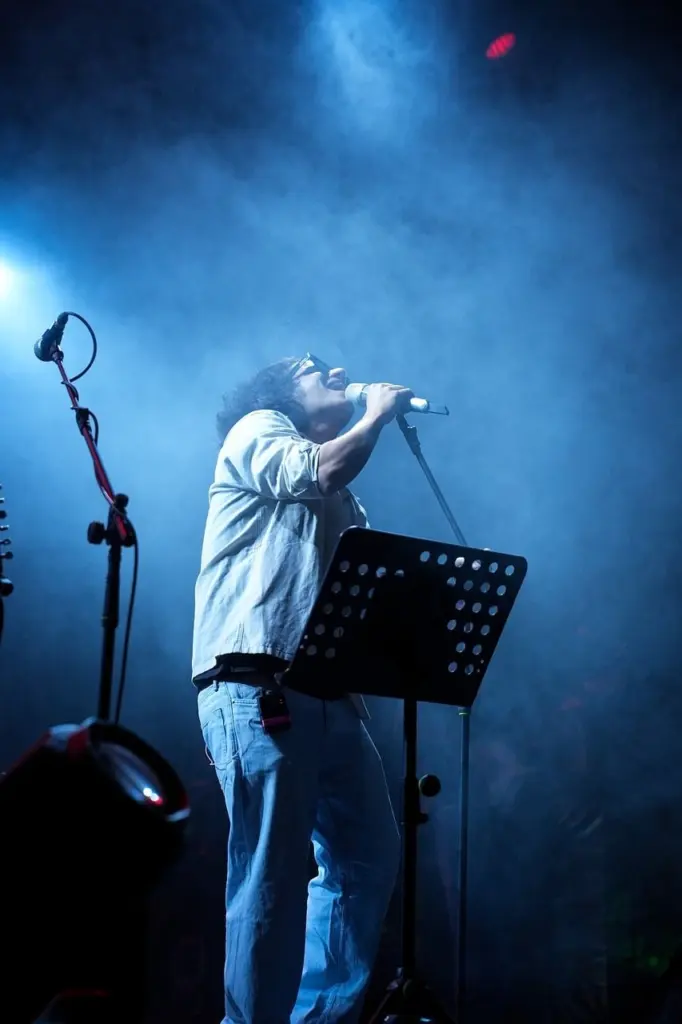
Dress to suit the event as the organizer describes it, and favor clothes you can stand and move in comfortably. Western festivals tend to welcome western working wear, but the stage outfit is your decision unless the performer guidelines say otherwise. The stock photo above shows casual clothing and is not a guide to western stage wear.
On hat etiquette, decide in advance rather than on the walk to the microphone. Choose whether you will wear the hat for the poem or leave it somewhere safe, and know where it will rest while you perform. Your hands are likely to be busy with a page, so a hat has no spare hand to be held in. If you are unsure of the room’s customs, watch the performers before you and ask the organizer.
Stopping points and when to wait
Climb the ladder one rung at a time, and pause at these checkpoints.
- Wait on a featured application if you have not yet performed before an audience. Complete an open mic first, ideally a daytime one in a small room.
- Choose a different gathering if the eligibility wording does not fit your background. The working-cowboy-environment condition quoted above is a stated condition at some events, not all.
- Do not apply until you have read the current guidelines for the year you want and can meet the submission requirements published there.
The route is worth the care. The Gathering, as the iWestern Music event listing puts it, encompasses western poets, musicians, artisans and storytellers, so a poet who prepares well sits within a broad community.
Frequently asked questions
How do I apply to be a featured performer?
Go to the gathering’s official performer guidelines or call-for-artists page. It will give the application window and what to submit. Where the event states who it invites, as some do, match your application to that description.
What is the difference between open mic and invited sets?
An open mic is an opportunity you request on the day or beforehand, whereas an invited or scheduled set is a slot the organizers have placed in the programme.
What if my nerves take over mid-poem?
It happens to experienced poets too. In the Western Folklife Center feature, a young poet with first-time jitters could not read her poem, and Rodney Nelson held the paper so she could finish. The feature describes these jitters as something all poets have had, so pause, breathe and carry on.
When is the next National Cowboy Poetry Gathering?
The 42nd National Cowboy Poetry Gathering, titled The Big Out There, runs Jan 25-30, 2027 in Elko, NV.