Among the singing cowboys of the movies, Gene Autry came first as a star. He made an unbilled screen debut in In Old Santa Fe (1934) and took top billing in Tumbling Tumbleweeds (1935), with Roy Rogers close behind.
Picture a viewer who stumbles on a black-and-white Western in which the hero pauses the plot to sing. That formula has deep roots in cowboy music. This listing ranks the performers by when they reached the screen and says what each added to the film, not just the record.
Singing cowboys at a glance
Three names carry most of the story: Autry, Rogers and the harmony group that produced Rogers. The table below sets out their screen markers and when each is the right starting point.
| Name | Screen marker | Screen contribution | Planning use |
|---|---|---|---|
| Gene Autry | Unbilled debut in In Old Santa Fe (1934); top billing in Tumbling Tumbleweeds (1935) | First big star of the craze; the film is considered to have launched the era | Start here for origins and the question of who came first |
| Roy Rogers | Under Republic contract from 1937; bought the palomino Golden Cloud (Trigger) in 1938 | Rival, then replacement for Autry; a star through the Second World War | Start here for the peak of the genre and the move to television |
| Sons of the Pioneers | Harmony group in which Len Slye was the sparkplug and middle voice | Supplied the singer who became Roy Rogers | Start here for vocal harmony and the group-singing side of the tradition |
The film details come from the Clarion’s history of the singing cowboys, and the star ranking from Time Is On Our Side’s singing cowboy profile.
1. Gene Autry: the first big star
Gene Autry is the answer to who was first when the question means the first star of the singing cowboy craze. Time Is On Our Side calls him the first big star of this kind. The distinction matters: the sources point to Autry as the first major name, not to a proven first singer ever to appear on a Western screen.
From unbilled debut to top billing
According to the Clarion, an unbilled Autry made his screen debut in In Old Santa Fe in 1934 and stole the show with three songs. The next step came with Tumbling Tumbleweeds, which gave him top billing and seven songs. It is considered to have launched the singing cowboy era.
The production detail explains why studios paid attention. The film was shot over seven days in July 1935 and released in early September. It cost around $18,000 and generated revenue exceeding $500,000. A cheap picture that returned that much made a singing lead an obvious bet.
What Autry added on screen
Autry’s contribution was structural. Songs became part of the Western’s running time, and the star carried them as himself rather than as a side attraction. A viewer who wants to see the formula before it was polished should begin with these two films.
His career then spread beyond the B-Western. His 1942 enlistment during the Second World War took him away from Republic, to the studio’s displeasure. His television series The Gene Autry Show debuted on CBS on July 23, 1950, and ran until Dec. 24, 1955. He later appeared regularly on the Forbes 400 listing between 1983 and 1994. He died on Oct. 2, 1998, aged 91.
Best for: readers who want the origin of the form. Limit: the 1934 appearance was unbilled, so the 1935 film is the clearer marker of a singing cowboy in a leading role.
2. Roy Rogers: rival, successor and brand
Roy Rogers was the performer who turned the singing cowboy into a long-running franchise. Born in Cincinnati, he lived from 1911 to 1998, and he was a star through World War II after replacing Autry following a contract dispute in the late 1930s.
A route through Republic
Republic Pictures had Rogers under contract from 1937, and the Clarion describes him as Autry’s biggest rival. Autry’s 1942 enlistment left Republic to promote Rogers in his place. The studio had already shown how quickly it could build a lead around a singer.
Trigger and merchandising
In 1938 Rogers bought the palomino stallion Golden Cloud, better known as Trigger, described by the Clarion as the smartest horse in the movies. He also negotiated merchandising rights. For a film-era listing, this is his distinctive screen contribution: the hero was a package of voice, horse and recognisable image, not only a singer.
Television and later years
NBC premiered The Roy Rogers Show on Dec. 30, 1951, broadcasting over a hundred episodes before its 1957 demise. He died on July 6, 1998, aged 86, of congestive heart failure.
Best for: readers who want the genre at its commercial height and the link between film stardom and merchandise. Limit: his rise depended on a studio structure and on Autry’s absence, so he is best read next to Autry rather than instead of him.
3. Sons of the Pioneers: the harmony group behind the screen star
The Sons of the Pioneers matter to Western film chiefly through a member. According to the Clarion, Len Slye was the sparkplug and middle voice of the popular harmony group before he auditioned at Republic and became Roy Rogers. In that account, the group was the training ground for the second great singing cowboy.
That gives the group a role that is easy to overlook. It did not launch the format, but it supplied a performer shaped by close vocal harmony, and Rogers carried that background into his screen career. Readers who want the songs this style produced can continue to the guide to cowboy songs.
Best for: listeners who care about group singing rather than solo stars. Limit: as a film story, the group appears here through Rogers, so it should be read as a vocal ensemble that fed the screen tradition, not as a rival star.

Why singing cowboys caught on in the 1930s and 1940s
The format spread because it was cheap, fast and well suited to the B-Western. The genre peaked in the 1930s and the early to mid-1940s and did not finally give up the ghost until 1954, according to the Clarion.
Studio economics
Republic remained the dominant player through the 1930s. The studio could reputedly get up to 100 scenes a day, a pace that suited low-budget pictures. The Tumbling Tumbleweeds budget and returns show the logic. A short shoot and a modest cost left plenty of room for profit.
Nostalgia for the West
Time Is On Our Side describes the craze as a nostalgic throwback or recreation of the American West. That is a useful corrective: the screen cowboy was a romantic image, and the songs were part of the costume as much as the realism.
How singing cowboys relate to country music
The supported answer is that the two overlapped but were not the same thing. The same source stresses that country and western music are two very different things, with country developing in the Appalachians in the early part of the century. The singing cowboy craze, by contrast, recreated the American West on screen.
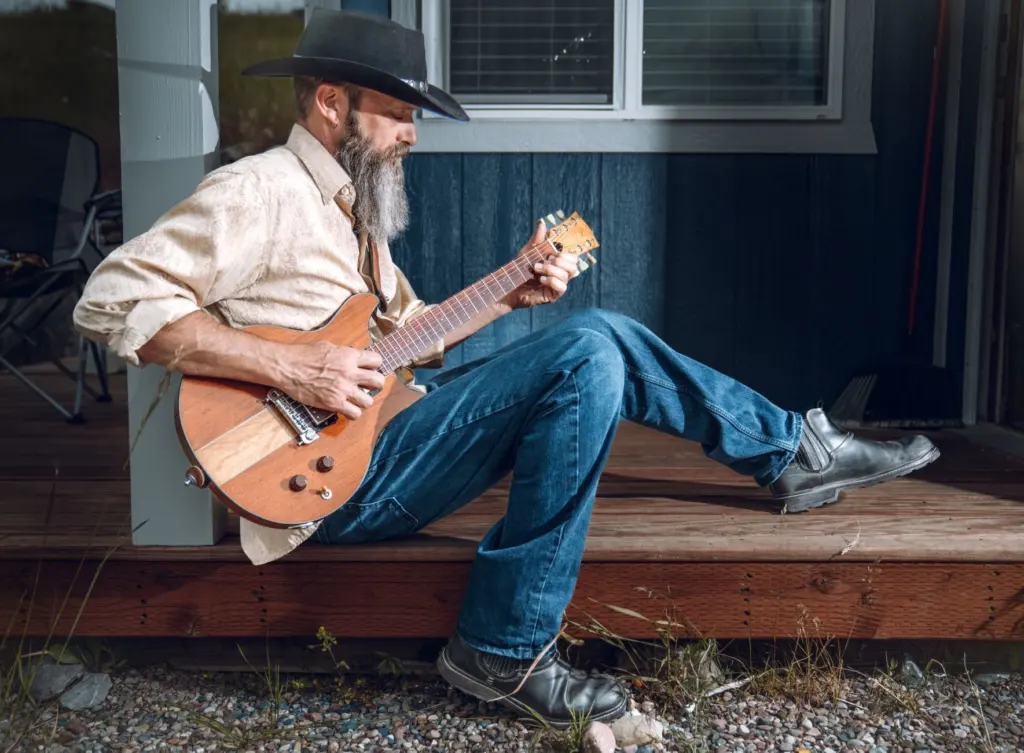
For readers, the practical consequence is to avoid treating every film cowboy as an early country star. Autry and Rogers belong first to Western film and its nostalgic image of the range, and only then to the wider story of American roots music. The performer’s instrument is a good bridge between the two, and the guide to cowboy guitar picks up that thread.
Choosing where to start
- Want the origin? Watch In Old Santa Fe for Autry’s unbilled debut, then Tumbling Tumbleweeds for the first top-billed vehicle.
- Want the peak? Move to Roy Rogers, whose Republic contract began in 1937 and whose Trigger partnership began in 1938.
- Want the harmony tradition? Look at the Sons of the Pioneers through Len Slye’s path to Roy Rogers.
- Want the television afterlife? Compare the CBS run of The Gene Autry Show with the NBC run of The Roy Rogers Show.
- Want the genre’s limits? Remember that country music and the singing cowboy craze are separate traditions.
Frequently asked questions
Who was the first singing cowboy in film?
Gene Autry is the first big star of the form. He had an unbilled debut in In Old Santa Fe in 1934, and Tumbling Tumbleweeds in 1935 gave him top billing.
Who were the most famous singing cowboys of the movies?
Gene Autry and Roy Rogers are the two names the sources keep returning to. Autry led the craze, and Rogers replaced him after a contract dispute in the late 1930s and stayed a star through World War II.
What did the Sons of the Pioneers have to do with Western film?
The group’s middle voice, Len Slye, auditioned at Republic and became Roy Rogers. That connection is the group’s clearest link to the screen cowboy.
When did the singing cowboy film genre end?
It peaked in the 1930s and early to mid-1940s and ended in 1954. Both leading stars then moved to television, with Autry on CBS from 1950 and Rogers on NBC from 1951.
Were singing cowboys the same as country musicians?
No. The craze was a nostalgic recreation of the American West, while country music developed separately in the Appalachians early in the century.